
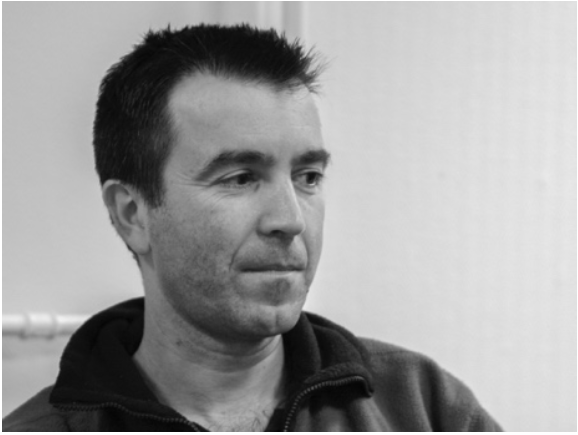
"A friend, colleague and member of the Marseille neuroscience community left us on October 2nd. Touched by his human qualities, his scientific ethics and his pedagogical conscience, we have decided to testify here to the roles he played as a researcher and teacher during 30 years.
Fabien Tell dedicated most of his research career to the study of the physiology of the brain structures responsible for visceral sensitivity, with a particular interest in the nucleus of the solitary tract (NTS), located in the brainstem, and the first central relay of visceral afferents. His first works, during his DEA and then his thesis in the Department of Physiology and Neurophysiology of the Faculty of Saint Jerome, were devoted to describe the different modes of discharge of the neurons of the NTS, and more specifically the role of the NMDA receptor in the triggering of action potentials bursts. These descriptions were greatly facilitated by the use of brain slice preparations, a technique set up in the laboratory by Fabien with the help of Laurent Fagni, then a young CNRS researcher. The methods used at that time were extracellular and intracellular microelectrode recordings, until Fabien brought back the patch-clamp recording technique from his post-doctorate in Robert Bradley's laboratory in Ann Harbor. With this innovative method at the time, Fabien participated in the description of the ionic currents underlying the activity of the NTS neurons, work that he started in the same department of Physiology and Neurophysiology where he had just obtained a position as a University Lecturer in 1992. He then continued this work in the ITIS laboratory (Integration of Sensory Information, CNRS Joseph Aiguier campus and later on the Faculty of Medicine North campus), studying the morphological and electrophysiological development of NTS neurons and then focusing on the properties of their excitatory synaptic inputs at the functional and morphological levels, through collaborations with other researchers in the laboratory. In 2008, he took the responsibility of a team within the newly created Centre de Recherche en Neurobiologie et Neurophysiologie de Marseille (CRN2M) and continued to study the glutamatergic synapses of the NTS, their development and their plasticity. Fabien then continued his research using computational modeling as a tool to understand neuronal excitability and synaptic activity. In 2018, he gave up his position as director of a research team and used this method to better understand the robustness of dopaminergic neuron activity in Jean-Marc Goaillard's team.
As this quick summary shows, Fabien's research career has been built on a constant evolution of the methodological approaches used (extracellular and intracellular electrophysiology, then patch-clamp, and finally computational modeling), reflecting a perpetual questioning and a great intellectual curiosity. Despite this evolution, Fabien has remained remarkably consistent in his values and scientific ethics throughout his career, even when this was not necessarily favorable to him. For example, when in 2008 he took over the management of a team composed essentially of CNRS researchers, he let himself be guided by his humanist and altruistic philosophy instead of submitting to the precepts in vogue in terms of management or to the diktats imposed by the evaluation authorities. Thus, he favored respect for the individual freedom of the researchers in his team instead of imposing a single line of research, a heterodox choice, to be sure, but one that had the effect of creating an unbreakable bond of trust with the researchers in his team. As a natural consequence, most of the researchers who worked with Fabien had a friendship with him that went far beyond the work. However, Fabien's intellectual and ethical demands could lead to lively exchanges of ideas, even with the colleagues he liked the most or with his hierarchical "superiors", emphasizing his insubordination and his conviction that science must be synonymous with a permanent questioning (of ideas and of oneself). All these qualities explain the unanimous esteem Fabien enjoyed among his colleagues.
During all these years, his altruism and his scientific enthusiasm were also expressed through his involvement in the Ionic Channels association. Between 1993 and 2018, Fabien participated in almost all the annual conferences of this association, as a member of the scientific organizing committee in 1995 and 1996 and by offering his help in the practical organization for more than 20 years. He leaves many members of this community with the memory of a passionate scientist who was also able to share moments of jovial camaraderie.
In parallel to his involvement in research, Fabien Tell was a respected teacher in the universities of Marseille for 30 years. He has taught excitable cell physiology and neurophysiology to undergraduate and graduate students throughout his career, particularly in transmitting the mathematical formalism of the biophysical processes underlying neuronal excitability to biology students who were often reluctant to learn. Following this same tropism, Fabien had evolved his teaching repertoire over the last few years, proposing courses on information processing based on computational modeling tools (in collaboration with Laurent Pezard) and developing a new teaching on the use of statistics in biology, in order to instill in young students a rigorous approach to this mathematical tool. He had also started to give a course on the epistemology of neuroscience to Master's students, conscious of the need to remind students of the historical and philosophical framework on which neuroscience was built. His intellectual intranquillity was therefore also manifested in his teaching approach: Fabien was constantly looking for new approaches and new methods to improve the teaching of neuroscience. These developments were not the result of demands imposed by the outside world, but rather the fruit of a critical and personal work on pedagogy and the state of knowledge, nourished by numerous readings on the philosophy and sociology of education. The numerous testimonies of sympathy that we have received from former students confirm, if it were necessary, that Fabien's pedagogical commitment was total. And even if his academic career was not crowned with laurels, he never sought them and was faithful to his commitments and convictions until the end.
For all these reasons, we wanted, as colleagues and friends, to testify to the influence that Fabien Tell had on the teaching and research in neuroscience in Marseille. After having faced the ordeals with a courage that forces respect during the last years of his life, it is today a great emptiness that he leaves within our community."
Text written by Olivier Bosler, Nadine Clerc, Christian Gestreau, Jean-Marc Goaillard, Bruno Mazet, Caroline Strube
